
|
IFA Social Sector Task Force webinar presented by Dr. Fiona Wilson, University of New Hampshire 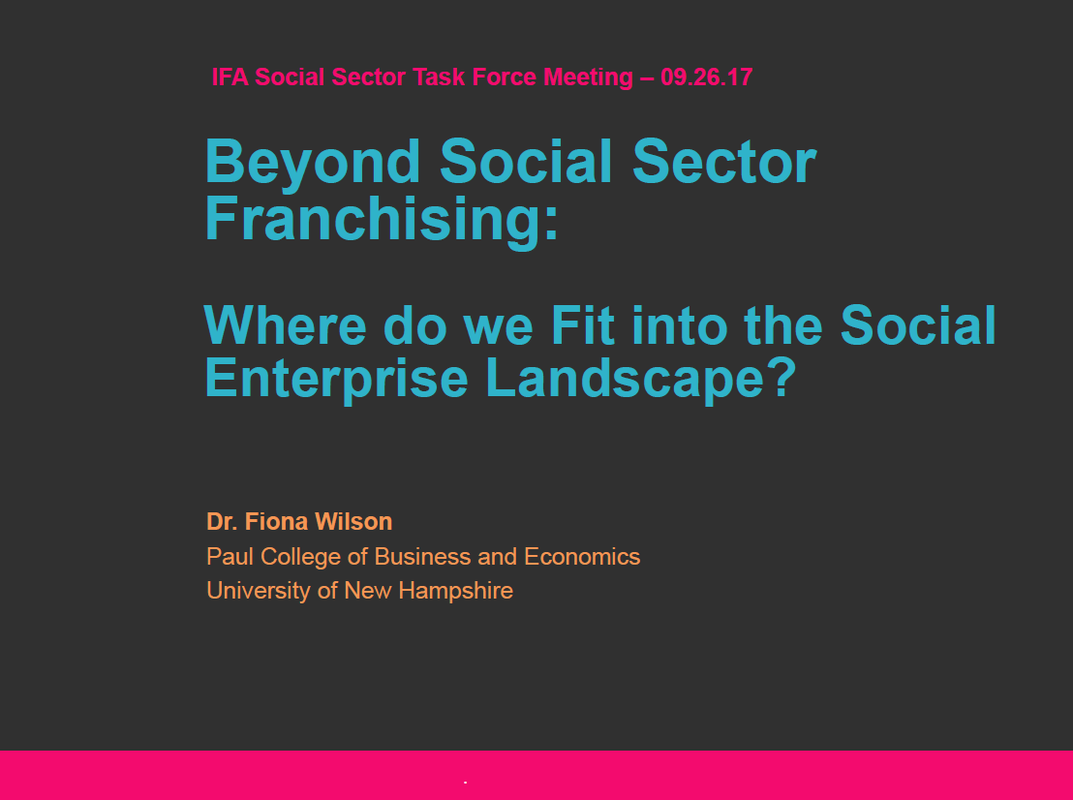 Access the webinar here:
https://www.franchise.org/file/ifa-sstf-beyond-social-sector-franchisingmp4 The University of New Hampshire is delighted to invite you to the Third Annual Social Sector Franchise Innovations Roundtable (SSFIR). SSFIR is a unique invitation-only conference convening a diverse
cross-section of social sector franchise entrepreneurs, commercial franchise experts, impact investors and donors, thought leaders, and scholars. When: October 18-19, 2017 Where: University of New Hampshire | Durham, NH, USA Our theme this year is “Moving from Pilots to Proven Concept: Tools, Metrics and Best Practices for Social Sector Franchising.” The two-day roundtable will include: Keynotes Greg Hills, Managing Director FSG Mr. Hills has over 20 years of experience advising organizations on strategy, program design, evaluation, and operational improvement, and co-leads FSG’s global corporate consulting practice advising multinational corporations on innovative shared value and CSR strategies. He has published numerous influential papers and speaks regularly on topics of shared value, CSR, collective impact, and philanthropic effectiveness. FSG is a mission-driven consulting firm for leaders in search of large-scale, lasting social change. Galen Welsch, Co-Founder and CEO, Jibu Galen co-founded Jibu in 2012 and under his leadership, Jibu has quickly become a toprated B-Corp social franchise bringing affordable drinking water access to thousands, and creating hundreds of jobs, mostly for youth, across East Africa. Galen’s achievements at Jibu have been recognized by BBC World, the Guardian, Fast Company, the Franchise Times, and by Forbes 30 under 30. He serves on the advisory board of the UNH Social Sector Franchise Initiative. Panel discussions • Innovative Measurement Breakthroughs in Health Sector Franchising • Building the Social Sector Franchise Ecosystem: Current Organizational Support for the Field • Developing a Research Agenda and Community of Practice to Catalyze the Growth of the Social Sector Franchise Ecosystem Updates on our inaugural Social Sector Franchise Accelerator • Check in on our Inaugural Living Case Studies • Introduction of the 2017-2018 Social Sector Franchise Accelerator cohort Networking You will join senior practitioners (from both the social sector and the private sector), investors, and thought leaders dedicated to furthering the use of the franchise methodology in the social sector. We invite you to engage with these participants about reimagining social change, sharing your perspectives on the potential for using franchising to deliver social goods and services, and your advice for how the nascent field can achieve growth. Learn more about the SSFIR agenda, registration and travel and hotel logistics here: https://www.unh.edu/social-innovation/ssfi/roundtable .  In 2015 the United Nations brought countries together to commit to eradicating poverty by adopting 17 sustainable development goals to achieve by 2030. The goals are ambitious and will require new approaches to solving some of the most pressing problems that plague people around the globe, even though solutions to those problems exist. How does this involve franchising? Read on!
Why disrupt the status quo? The technology for meeting basic human needs for healthcare, nutrition, safe drinking water, sanitation, clean energy and education all exist and yet all too often, the solutions are not finding their way to the people who need them. Clearly, traditional approaches are insufficient. President Bill Clinton famously said, “Nearly every problem has been solved by someone, somewhere. The challenge of the 21st century is to find out what works and scale it up.” No-one is better equipped to meet that challenge than people who are familiar with the tools of commercial franchising. Solving basic needs Franchising has the potential to increase access to products and services that solve basic needs by scaling the concepts that have already been developed and proven to be both socially impactful on the community, and profitable to the business owner. Franchises of this type are often referred to as ‘social franchises’. In addition to solving social needs, social franchises, like commercial franchises, have the potential to stimulate economic growth by bringing businesses into communities, creating jobs and wealth opportunities and developing building skills that can be transferred outside of the franchise. By doing so, they can also create a middle class. From RNews  Reacting to the Statistician-General of Statistics SA Quarterly Labour Force Survey that shows unemployment rising to a 14-year high with 27.1% of the population without a job, the Franchise Association of South Africa (FASA) believes the franchise sector, which contributes 11.6 percent to the country’s GDP and employs over 400 000 people through its 757 franchise systems and their 35 111 franchise outlets, can play a key role in creating the necessary jobs to grow the economy through innovative venture creations.
With the gap between the unemployment rate envisaged by the National Development Plan (NDP) and the current rate widening and with Government’s goal of 5 million jobs by 2020 fading fast, the only solution for real economic growth to happen, is if 90% of South Africa’s jobs come from small business. Says Tony Da Fonseca, FASA’s Chairman for 2017/2018, “Solutions to the employment challenge need to be tackled as a matter of urgency. We as the franchise community have the business format expertise to assist in the establishment of new franchises in a variety of sectors not yet franchised – be it in agriculture, manufacturing or even in government’s social services. But we need to mobilise business and industry leaders, government and civil society to play a part in freeing up economic regulations and find creative solutions to allow entrepreneurship to flourish.” It has been proved time and again that small and medium enterprises (SME’s) are the backbone of every economy around the world. According to Vera Valasis, Executive Director of FASA, who represents South African at the World Franchise Council, “small businesses are creating two thirds of the jobs in developed countries and a large percentage of those small businesses are through the franchising business format. There is no reason why South Africa cannot drive the same growth through franchising that countries such as Brazil, China and India have shown.” Many of the Franchise Association’s members are already exploring new ways to empower small businesses and entrepreneurs in bridging inequality, creating prosperity and employment. According to Anita Du Toit, Director at Franchising Plus, franchise consultants who have pioneered the piloting of social franchise projects, there should be more programmes with a focus on skills development and that certain skills could be turned into sustainable micro franchises, thereby helping these franchisees to earn a living and removing them from the job seeking market. “We have always said that painters, tilers and such trades could be franchised under the umbrella of a big retailer or paint manufacturer. This would solve the problem of consumer perceptions of the credibility of independent contractors while also ensuring a central referral system, ongoing training and support and helping such tradesmen to earn a good living as a small business operator. The focus should move from job creation to the creation of sustainable small businesses. Franchising offers a mechanism to enable this.” Kobus Oosthuizen, former Chairman of FASA and MD of SA Franchise Warehouse, has, for the past few years worked closely with government on several initiatives to stimulate entrepreneurship, skills transfer and job creation. In 2014, an initiative from the Jobs Fund, and in conjunction with Business Partners, resulted in just under R100 million advanced and more than 600 jobs to be created by the end of 2017. The second round of an emerging franchisor initiative spearheaded by the Department of Small Business Development’s Micro Franchisor Development Project will see the number of businesses replicated total twelve. “There is no doubt that these projects” says Kobus Oosthuizen, “will go a long way to enhancing the reputation of franchising as an enterprise development mechanism, whilst playing a valuable role in reviving township economies, creating new businesses, passing on important skills and more importantly, creating much needed jobs.” Tony Da Fonseca, MD of the OBC Group and Chairman of the Franchise Association of South Africa (FASA), believes that the franchise sector is perfectly poised to take the lead in transforming the business landscape and make an even bigger contribution to entrepreneurship, skills transfer and job creation. “As a group of progressive franchise entrepreneurs, historically and against the odds of sanctions, we created a franchise sector that today boasts over 90% home-grown concepts. Sustainable economic transformation can become a reality only if the public and the private sector come together to optimise limited resources and utilise available opportunities to best effect,” says Da Fonseca. The franchise community will gather at the annual FASA Convention sponsored by Absa to network with industry stalwarts who will be sharing their leadership styles and how they are tackling the challenges in franchising. The Convention takes place on Thursday 29th June at the Kyalami Grand Prix Convention Centre from 08h00 to 16h45 ahead of the Franchise Business Festival which takes place from the 30th June to the 2ndJuly – showcasing franchise and business opportunities. For more information visit www.fasa.co.za or email [email protected] Dr. Rozenn PERRIGOT Associate Professor Director of the Center in Franchising, Retail & Service Chains Graduate School of Management (IGR-IAE Rennes) University of Rennes 1 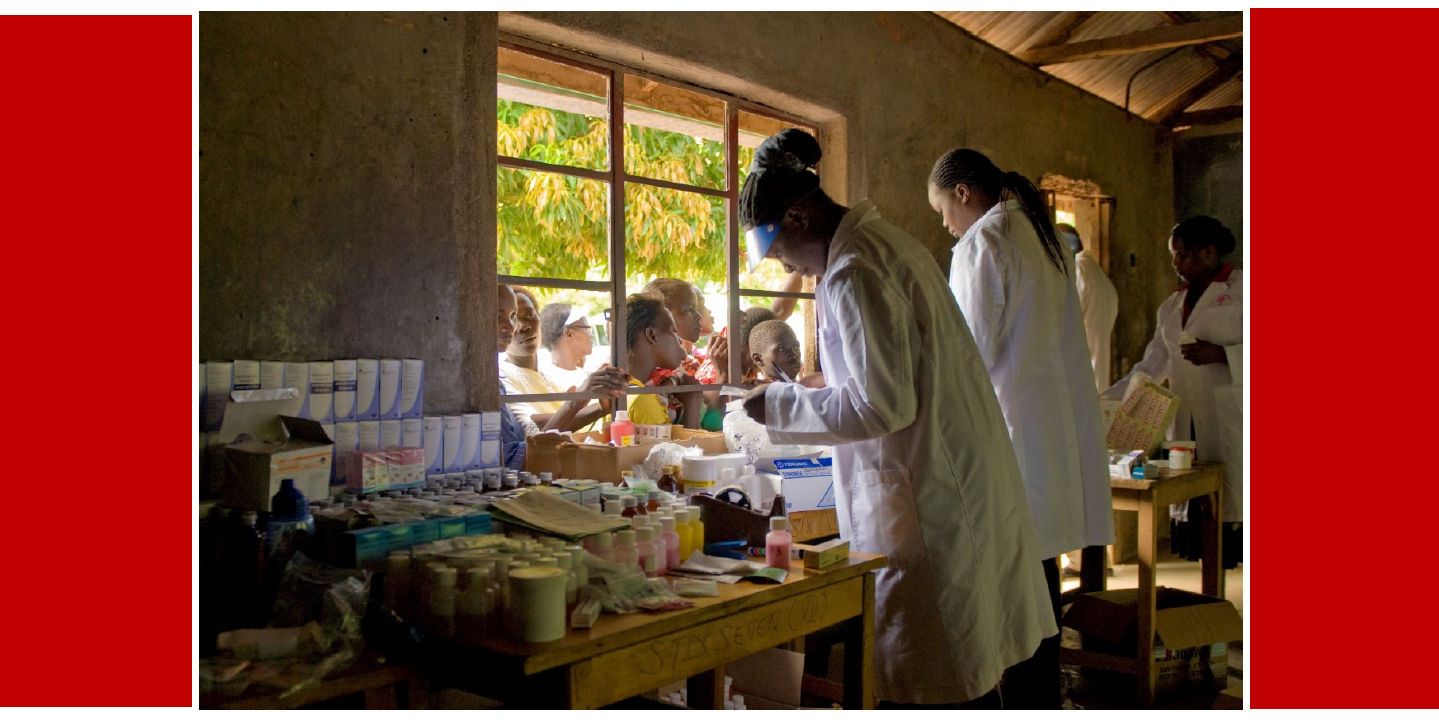 EXECUTIVE SUMMARY
In the context of the growth of franchising in the social sector, and more specifically in the health care sector in Africa, it is important to understand how franchising can contribute to the development of the sector, from the quality of treatment and services offered to the performance of the companies. This CFW network case study’s objective is to understand and assess:
The methodology of this exploratory study is qualitative and based on:
This multi-level approach involving people from headquarters, franchisees, an employee of a clinic, customers and a prescriber has allowed me to gain a global overview of CFW activities and operations, the CFW franchise business model and CFW challenges and future prospects. The following findings and recommendations have emerged from this study: Valorizing CFW organizational know-how: In addition to the know-how that has been implemented and codified by CFW before being transferred to the franchisees, CFW has important organizational know-how at the headquarters’ level. Specifically, I refer to the codification of the business know-how, franchisee training, the audit of the clinics and the supply of medicines. Another example of relevant organizational know-how of CFW is the CFW Outlets Compliance Code that is “a code for the Field Officers on how to handle non-compliant CFW franchisees. It defines contraventions of specific CFW franchise standards so as to clarify the relevant steps an officer should take.” It would be appropriate to proceed to a detailed audit of all this organizational know-how and valorize it:
Considering the evolution of the CFW concept: In terms of evolution of the CFW concept, it appeared during the interviews that there was an interest in expanding the services offered by the CFW clinics, as well as opening hours of the clinics. First, according to CFW customers, services and facilities provided by the CFW clinics could be expanded. Interviewees mentioned specifically vans, deliveries, laboratories as well as adding wards for in-patient care. On the one hand, this would be a way to better meet customers’ demands and, on the other hand, a way for the franchisees to develop their activities and then make more money. Second, two customers who would like 24H/24 service also suggested expanding the opening hours of the clinics. The associated issue would be the cost associated with expanded opening hours. Better assessing customer needs and expectations: In addition to this exploratory qualitative study, a questionnaire-based survey given to customers would be very useful in order to assess customers’ needs, expectations and also satisfaction.  Living Case Study Webinar -- Measuring Social Sector Franchise Impact: How Lean Data measurement can help improve franchise impact and success Wednesday, June 7, 2017 10:00 a.m. - 11:00 a.m. (EST) Online By definition Social Sector Franchises promise to deliver needed goods and services at scale with measurable social impact. While a large number of tools and frameworks are available for measuring impact there are limitations to how well they will keep up with franchise growth without becoming prohibitively cumbersome or costly. In this webinar we will review a few of the more common approaches to impact measurement and their limitations and will learn about an exciting new tool for impact measurement developed by Acumen. In its application across the globe Lean Data is making it possible for social enterprises get accurate and timely data at relatively low cost and ease of implementation. Guest moderator Fiona Wilson, Executive Director of the Center for Social Innovation and Enterprise will be joined by Greg Starbird a social franchise expert to discuss the importance and challenges of impact data measurement in social sector franchising. Fiona and Greg will be joined by Ashley Speyer Acumen’s Lean Data Senior Associate who will describe this exciting methodology and give examples from its use with several of Acumen’s social businesses. A question and answer segment will give broadcast viewers a chance to interact with our webinar guests. REGISTER NOW 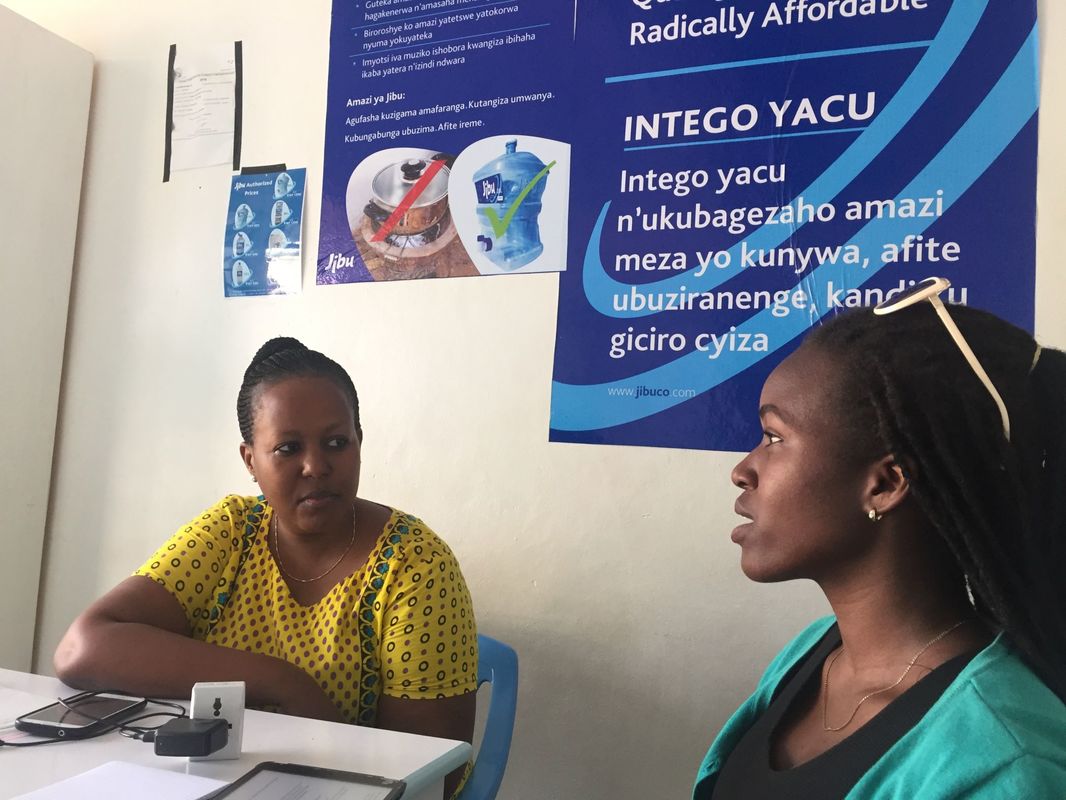 Living Case Study Webinar -- Creative financial models to drive social franchise success There are a range of investment vehicles currently used to support social sector franchises in health, water, sanitation, education, clean energy, and agriculture. Each is attracted to the tremendous potential that the franchise model can deliver for social and financial returns. That potential can only be realized when social franchises are developed in a methodical way that requires different types of resources at various stages of growth. Better coordination among financing institutions to create blended financing options that drive healthy growth of social franchises will benefit investors, investees, and the people that social sector franchises serve. In our second webinar guest moderator Julie McBride of MSA Worldwide will engage guests in a discussion around current financial products and investment practices and opportunities for creating more strategic ways to support social franchising. Guests include Michael Swack from the Center for Impact Finance at UNH a leader in the impact investment field, John Simon from TOTAL Impact Capital, a boutique finance firm specializing in sourcing and developing private investment opportunities that are socially and financially attractive and Randy Welsch, Co-founder of Jibu, a for-profit business with the integrated goals of making money and making charitable impact. WATCH THE RECORDING DOWNLOAD THE POWERPOINT PRESENTATION  First Living Case Study Webinar -- Jibu Rwanda - Infusing Lessons Learned for Intelligent Scaling The Center for Social Innovation and Enterprise's Living Case Study Social Sector Franchise Accelerator is an action learning and research project, which will take place over eight months with three entrepreneurs who are new or emerging social sector franchisers. Jibu is rapidly expanding its clean water franchising in East Africa recently opening a new franchise center in Kigali, Rwanda. Our first webinar moderated by Bill Maddocks will explore how Jibu’s expansion is progressing and we will talk with LCSA protégé Mark Mutaahi, his mentor Peter Holt, Jibu co-founder Galen Welsch and Rwanda country director Nathan Dowling about operational challenges including the need for proper training and data to drive decision making as franchisees are recruited and a marketing strategy is plotted.
Broadcast participants are encouraged read the LCSA Jibu page and blog entries and come to the webinar ready to ask questions and be active members of this real time learning opportunity. WATCH THE RECORDING Could social franchising solve the problem of scale up within the UK National Health Service?5/24/2017
The International Centre for Social Franchising (ICSF) was born out of frustration that successful solutions often fail to scale, so social organisations waste scarce resources by needlessly reinventing the wheel. ICSF seeks to identify, ‘scale’ (replicate) and share ideas that work. Over the past five years that’s taken a lot of different forms, using innovative replication models to scale the use of buses that allow homeless people to shower and keep clean in San Francisco, with Lava Mae, to working with NSPCC’s Baby Steps team, increasing support to new parents to care for and reduce the stress associated with the arrival of their new baby.
New solutions for the NHS? The NHS is under constant pressure to find solutions that have the potential to improve health care outcomes or deliver cost savings at scale. This has become even more apparent to me over the past few months as I’ve explored scaling up in the UK health care sector more closely. ICSF has been travelling across the country to meet with project teams that have been supported by the Health Foundation. We’ve seen inspirational clinicians and managers who go above and beyond every day, to invest in improvement and innovation solutions to boost health care outcomes. The landscape of possible solutions is diverse, ranging from delivering multi-disciplinary support to advanced symptom Parkinson’s patients, to preventing prescribing errors in GP practices. But too often these solutions exist as isolated pockets of excellence and are infrequently implemented at wider scale locally or nationally. As we explored the specific challenges of replication within the UK health care sector we found that a popular way to ‘scale up’ an approach or intervention to improve patient care is through sharing best practice. ICSF calls this activity ‘dissemination’. It can work excellently for particular solutions or contexts, for example clinical networks - where clinicians share best practice and ideas for making small scale changes to practice. But for other approaches and interventions, particularly those that are more complex, dissemination alone can be insufficient. To begin to understand why dissemination only works for some solutions or contexts, we listened and we learned through available literature and interviews with people working in the health care sector. We heard time and again about the challenges associated with dissemination – that more support was needed to create behaviour change, or that there was a lack of clarity about the approach or intervention being scaled up. We believe more structured ways of replication such as social franchising or licensing have particular potential to help scale solutions across the NHS. Social franchising is based upon the commercial franchising model where companies, such as the Body Shop, use franchises to expand. Our chief executive Dan Berelowitz spent time with The Body Shop, McDonald’s and some great social enterprises, understanding what makes replication and franchising work. In this model a proven business model is ‘boxed’ up and passed on to others to replicate with appropriate support. Social franchising follows the same principle, allowing an organisation to package what works and provide support to others to adopt it, with a focus on replicating impact. This retains the essence and fidelity of the core elements of the approach, while remaining flexible and open to adaptation to the local context. It is this model that we recommended to NSPCC for scaling their Baby Steps programme, with the charity transitioning from being the direct provider of the service, to acting as a franchisor overseeing implementation by local mainstream organisations such as Children’s Centres and also by midwifery teams. We believe this model enables NSPCC to ensure fidelity to the evidence-based model, whilst enabling local ownership. Case study: Can this model be translated to a primary care setting? One of the project teams we met with to explore these replication models was the team responsible for IRIS (Identification & Referral to Improve Safety), a general practice-based domestic violence training, support and referral programme for primary care staff. Since beginning the research trial in 2007 to becoming a commissionable model in 2010, IRIS has been commissioned across the UK, leading to increased identification and referrals for victims of domestic violence. Having successfully scaled to date by responding to requests for their service, the IRIS project team is now at a point in their scale journey where the team wants to be more proactive in its replication approach.  Click here to access the webinar recording
*The mission statement of the Social Sector Task Force is: “To Enhance The Quality Of Life In Underserved Populations – One Opportunity At A Time”. The members of the Task Force – all drawn from our IFA Family – in addition to sharing best practices, provide mentoring and coaching to NGOs and Social Franchisors. Presenters: Michael Seid Managing Director MSA Worldwide Julie McBride Senior Social Franchising Advisor MSA Worldwide Marla Rosner Senior Learning & Manuals Consultant MSA Worldwide During the Franchising and Multiple Bottom Lines panel at IFA’s 2017 Convention there was confusion about whether and how restaurants can donate excess food. IFA reached out to our friends at the National Restaurant Association who shared the following details on the The Good Samaritan Food Donation Act. The Good Samaritan Food Donation Act
Increasing food donations to charitable organizations is one of the best ways restaurants can reduce food waste and divert material from landfills. However, some restaurants are reluctant to donate their excess food due to fear of liability exposure if that food were to cause a foodborne illness. Fortunately, federal law provides liability protection for food donated in good faith. In 1996, Congress passed the Bill Emerson Good Samaritan Food Donation Act that provides civil and criminal liability protection to businesses that donate food. The Act protects donors as long as they meet the following requirements:
What’s Good Faith? While the statute does not specifically address what constitutes good faith, this familiar legal concept embraces conduct that is motivated by a sincere and honest intention to deal fairly with others and that the donor believes the food to be safe for consumption. What’s Apparently Wholesome Food? Food that meets all federal, state, & local quality and labeling standards even though the food may not be readily marketable due to appearance, age, freshness, grade, size, surplus, or other conditions. Are there any exceptions? Under the Act, as long as the donor has not acted with gross negligence or intentional misconduct, there are no exceptions: the company is not liable for damage that might be incurred as the result of illness. Does this conflict with state laws? The Act provides federal protection and preempts all state laws that provide less liability protection than the Bill Emerson Act. States are of course free to provide greater liability protection than the federal law. In the past, a patchwork of state laws essentially required a comprehensive survey of the law in all states and the adoption of jurisdiction-specific recovery practices. Now, food donors need only seek protection under one law and do not need to investigate liability laws, nor pursue protection in 50 states. Has anyone been sued for a foodborne illness? Millions of pounds of food are donated daily and not a single case involving food donation-related liability has been reported. The absence of litigation demonstrates that fear of lawsuits or other negative publicity related to mishaps with donated food are overstated and largely illusory barriers to food recovery. State and Local Health Regulations The Act does not waive state and local health regulations. All restaurants donating food must still comply with all state and local health regulations, which are typically no different from those required for retail sale. Source: Legal Guide to the Bill Emerson Good Samaritan Food Donation Act, University of Arkansas, http://media.law.uark.edu/arklawnotes/2013/08/08/the-legal-guide-to-the-bill-emerson-good-samaritan-food-donation-act/#note-1448-168 |
Blog Team
Posts on our blog are contributed by a team of professionals dedicated to developing valuable resources for the Social Sector Franchising community. Archives
May 2024
|
 RSS Feed
